
How Speech Therapy Helps Children Improve Communication Skills
A parent once described the moment their four year old finally said “I want water,” instead of pulling them toward the kitchen. Tiny sentence. Huge victory. That’s what therapy is often about: not perfection, but the small breakthroughs that make everyday life feel easier for a child and their family. Many parents still feel unsure about what speech therapy for children actually involves, whether it’s just “practising words,” and whether their child needs it. This guide answers those questions plainly.
Advanced Speech and Hearing Clinic in Jasola, Delhi, works with children of different ages and needs, so the examples below reflect what families commonly encounter.
What Is Speech Therapy, Really?
It’s a structured, evidence-based way of helping children understand language, express themselves and produce clear speech. A speech-language pathologist looks at the full picture: how the child listens, understands, talks, plays, socialises, and even eats, since the same mouth muscles are involved. Therapy is then built around the child’s own strengths and challenges.
Who Can Benefit?
Speech therapy isn’t only for children who aren’t talking at all. It can help with:
- Late talking or delayed language development
- Unclear pronunciation or articulation errors
- Stuttering or stammering
- Speech and language difficulties linked to autism spectrum disorder
- Communication problems tied to hearing loss, including children with hearing aids or cochlear implants
- Childhood apraxia of speech, where the brain finds it hard to plan mouth movements
- Cerebral palsy or other conditions affecting muscle control
- Voice problems, like a persistently hoarse voice
- Difficulty understanding instructions or telling stories
- Feeding and swallowing difficulties in some cases
What Happens in a Session?
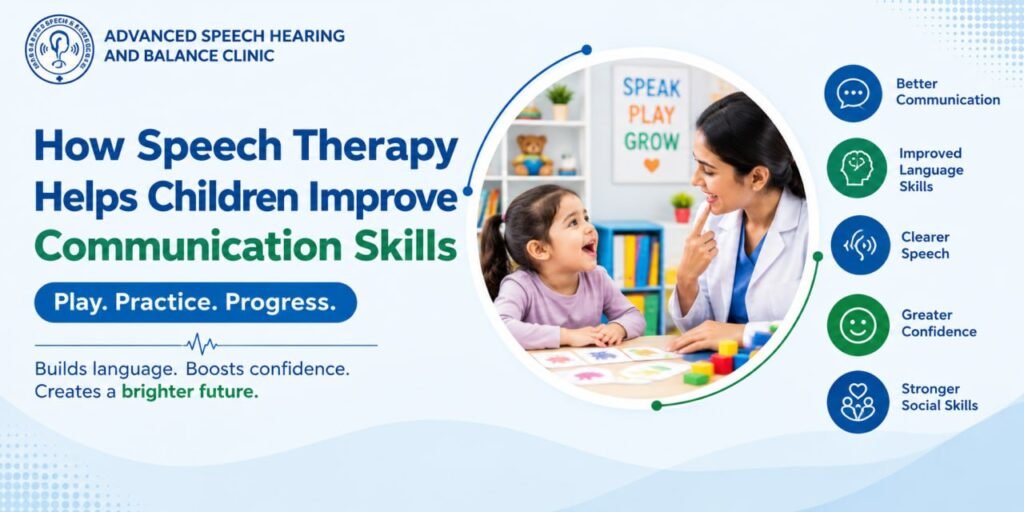
Forget the image of a child sitting quietly at a desk repeating words. Sessions for young children look a lot like play, and that’s deliberate.
- Play-based activities: Games, toys, bubbles and books encourage natural communication
- Modelling: The therapist demonstrates words and sounds, and the child imitates at their own pace
- Picture cards and visual supports: Helpful for building vocabulary and understanding
- Oral motor exercises: Strengthening and coordinating the lips, tongue and jaw where needed
- Sound practice: Working step by step from sounds to syllables, words and sentences
- Story and conversation skills: Turning simple words into real back and forth communication
- Alternative communication tools: For some children, gestures, picture boards or devices can support speech rather than replace it
Beyond Words: Other Skills That Grow
Here’s something many parents don’t expect. Therapy often improves more than speech.
- Confidence: A child who is understood is a child who speaks up
- Behaviour: Many tantrums fade when a child finally has a way to say what they need
- Social skills: Taking turns, listening and sharing become easier
- Learning: Language strength supports early reading and writing
- Family life: Less frustration all around, for everyone
The Parent’s Role Is Bigger Than You Think
A weekly session is only a small slice of a child’s week. What happens at home carries the change forward.
- Practice the simple activities the therapist recommends, even for five to ten minutes a day
- Talk about what you’re doing during routines like bath time and meals
- Give your child time to respond, and resist finishing their sentences
- Celebrate every attempt, not just perfect words
- Keep screens limited, and choose interactive play when possible
- Stay consistent, because progress builds through repetition
How Long Does It Take?
There’s no single timeline, and any promise of a quick fix should raise eyebrows. Progress depends on the child’s age, the type and severity of the difficulty, other health factors, how regularly they attend and how much practice happens at home. Some children need a few months of focused support. Others benefit from longer-term therapy. What matters is steady, measurable movement, which a good therapist tracks and shares with parents.
Signs It May Be Time to Book an Assessment
- No words by 18 months, or no phrases by 2 years
- Speech that’s hard to follow after age 3
- Stuttering that lasts or worsens
- Difficulty following simple instructions
- A child who avoids talking or seems very frustrated when communicating
- Regression, or loss of previously learned words
An assessment also usually includes a hearing check, since hearing difficulties can hide behind speech problems.
Final Word
Communication is more than talking. It’s connection, and it’s how children tell the world who they are. With the right support, many children make real, lasting gains, and families find a lot of relief in finally having a plan. If you’re considering speech therapy for children and don’t know where to begin, Advanced Speech and Hearing Clinic in Jasola, Delhi, can offer a thorough assessment and a personalised approach. Start with a conversation, and let your child’s voice take it from there.