
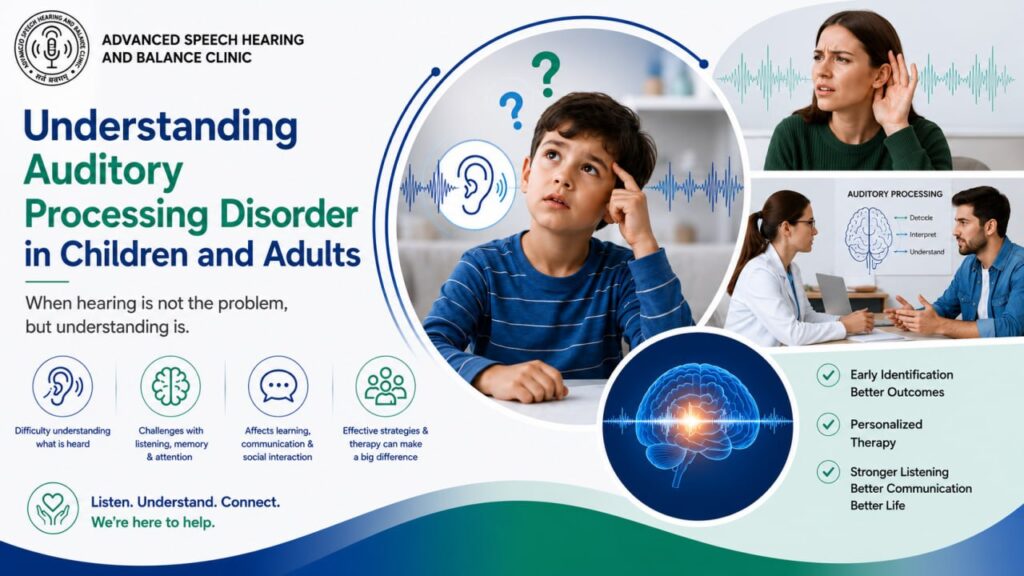
Understanding Auditory Processing Disorder in Children and Adults
Hearing sound and actually understanding it aren’t the same thing, and that gap trips up more people than you’d expect. Someone can walk out of a standard hearing test with flawless results and still find it exhausting to follow a conversation the moment there’s noise around them. That’s auditory processing disorder in a nutshell, and it’s way more common and way more misread than most people assume.
What’s Really Going On With Auditory Processing Disorder
APD happens when the brain struggles to make sense of sound signals, even though the ears are functioning perfectly fine. Sound gets delivered to the brain just as it should, but somewhere in that process of sorting and decoding it, things fall apart. It has nothing to do with how loud something is and everything to do with how clearly the brain can untangle it, especially amid background chatter, several people talking at once, or fast speech.
That difference matters a lot because so many kids and adults dealing with APD end up completely misunderstood. Parents figure their child just isn’t paying attention. Teachers assume distraction. Adults quietly blame themselves for being unfocused or scattered. But the real cause runs much deeper than any of that, buried in how the brain actually interprets sound.
Catching the Signs of Auditory Processing Disorder in Children
In kids, APD often looks a lot like an attention problem on the surface, which is exactly why so many cases go unnoticed for years. A child might struggle to follow instructions with several steps, particularly in a loud classroom, or constantly ask for things to be repeated even though their hearing tests come back completely fine. Reading and spelling troubles sometimes trace back to APD too, since making sense of sound plays a real role in connecting letters to how they’re supposed to sound.
One of the more telling Signs of Auditory Processing Disorder in Children is a sharp difference in how they perform one-on-one versus in a group, where overlapping voices and noise make it noticeably harder to keep up. Teachers tend to notice this before parents do, mostly because classrooms expose the pattern more clearly than a quiet house ever would.
Adults Experience It Somewhat Differently
Adults navigating APD, whether it’s just been diagnosed or they’ve lived with it unknowingly for years, describe strikingly similar struggles just in their own words. Keeping up with conversations at restaurants or in meetings starts to feel draining instead of enjoyable. Phone calls end up harder to follow than talking to someone face to face. Many say they have to concentrate so hard just to keep pace with a discussion that others seem to follow without any effort at all, leaving them mentally drained by the time the day ends.
Interestingly enough, APD in adults sometimes shows up or gets worse after a head injury, years of untreated ear infections, or certain neurological conditions, though in a lot of cases, it simply went undiagnosed since childhood.
Why an Accurate Diagnosis Actually Matters
Regular hearing tests only check whether sound is reaching the brain, not how well the brain is actually making sense of it, which is exactly why APD slips through the cracks so often during routine checkups. Getting it properly diagnosed requires specialised testing that looks at things like understanding speech in noisy settings, quick auditory sequencing, and dichotic listening tasks.
Without that kind of accurate diagnosis, kids risk being labelled with completely unrelated learning or behavioural issues, while adults often end up blaming themselves personally instead of recognising that what they’re dealing with is real, explainable, and manageable.
Practical Ways to Handle APD Day to Day
APD isn’t something that just fades away over time, but there’s plenty that genuinely helps make daily life easier. For children, adjustments like preferential seating in class, cutting down background noise, and pairing spoken instructions with visual cues go a long way. Auditory training exercises built to strengthen how the brain processes sound over time are also frequently recommended for children showing early Signs of Auditory Processing Disorder in Children.
For adults, small tweaks, such as choosing quieter spots for meetings, turning on captions during video calls, or asking someone to put things in writing, can noticeably ease the daily strain. Assistive listening devices sometimes help close that gap too, between what’s actually said and how clearly the brain manages to process it.
Getting the Right Kind of Help
If any of this sounds familiar, whether you’re a parent picking up on these patterns or an adult who’s quietly struggled for years, getting evaluated properly can genuinely change things. Advanced Speech and Hearing Clinic offers specialised auditory processing evaluations that go far beyond a standard hearing check, pinpointing exactly where the difficulty lies and building a realistic plan from there.
Realising this is an actual, diagnosable condition and not some discipline problem or personal weakness is often the first real sense of relief people feel. The team at Advanced Speech and Hearing Clinic works closely with both children and adults to make sense of these challenges and put practical support systems in place, so listening finally stops feeling like a constant uphill battle.